Research
Structural color is a coloration phenomenon that arises not from pigments, but from the interaction between light and micro/nanostructures, and is widely observed in both biological and artificial materials. Owing to its characteristic optical responses, such as vivid coloration and angle dependence, it has attracted considerable attention in both fundamental science and material applications.
My research focuses on understanding the relationship between structure and optical response in systems such as colloidal self-assembled structures and biological photonic crystals. Furthermore, based on these insights, I aim to develop structural color materials with high color saturation and low angular dependence.

Photonic Balls
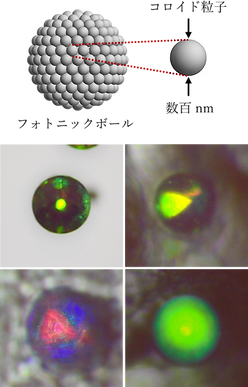
Photonic balls are microscale crystalline structures formed by the spherical assembly of colloidal particles. Owing to their spherical geometry, they exhibit optical properties distinct from those of planar colloidal crystals, and are expected to be useful for applications such as structural color pigments and optical materials.
I have investigated photonic balls with different particle sizes and analyzed their reflection spectra and angular dependence. These studies revealed that the crystal planes responsible for coloration change depending on the particle size [1]. In particular, for smaller particles, reflection from the (111) planes at the central region is dominant, whereas for larger particles, reflection from the (220) planes near the surface contributes to visible coloration [2].
Furthermore, cross-sectional observations of the internal particle arrangement revealed multiple structural types, including FCC single crystals, layered FCC domains, icosahedral structures, decahedral structures, onion-like structures, polycrystalline aggregates, and amorphous structures [3]. These results demonstrate that spherical colloidal clusters do not form a single structural type but instead exhibit a variety of internal structures depending on formation conditions. In particular, icosahedral and decahedral structures show characteristic reflection patterns such as triangular and teardrop shapes, whose origins have been elucidated through correlation with their internal structures [4,5].
Through these studies, I aim to establish the relationship between structure and optical response in photonic balls and to provide design guidelines for structural color materials.
-
R. Ohnuki et al., Langmuir, 36, 5579-5587, (2020).
-
R. Ohnuki et al., Advanced Optical Materials, 7, 1900227, (2019).
-
R. Ohnuki et al., ACS Appl. Nano Mater., 6, 13137–13147, (2023).
-
R. Ohnuki et al., Particle & Particle Systems Characterization, 39, 2100257, (2022).
-
R. Ohnuki et al., Chem. Mater., 36, 2953–2962, (2024).
Biological Photonic Crystals
Many organisms produce vivid structural colors by controlling light interference through nanoscale microstructures. In particular, insect scales often contain three-dimensionally periodic photonic crystals, whose geometries are closely related to triply periodic minimal surfaces (TPMS).
Representative examples of such structures include gyroid-type photonic crystals found in butterfly scales and diamond-type photonic crystals observed in weevils.
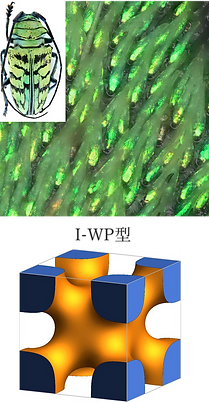
In the scales of a longhorn beetle, I discovered a photonic crystal based on the I-WP minimal surface, which had not been previously reported in biological systems [6]. Three-dimensional reconstruction using FIB-SEM, combined with structural analysis, revealed the orientation of crystal domains and the presence of twin-like structures. In addition, photonic band calculations showed that the band gap along the (110) direction is responsible for the observed green reflection.
Furthermore, I investigated the optical response of this photonic crystal in detail and revealed a characteristic polarization-dependent reflectance spectrum [7]. In particular, under crossed polarizers, a unique spectral shape with two peaks appears, and its origin was explained based on the symmetry of the electromagnetic modes.
Through these studies, I aim to deepen the understanding of the relationship between structure and optical response in biological photonic crystals.
6. Y. Kobayashi, R. Ohnuki et al., Journal of the Royal Society Interface, 18, 20210505, (2021).
7. R. Ohnuki et al., Physical Review E, 106, 014123, (2022).
Structure × Light
My research has focused on elucidating the relationship between structure and optical response in systems such as photonic balls formed by the self-assembly of colloidal particles and biological photonic crystals. In these systems, differences in crystal structure, orientation, and domain structure are directly reflected in optical properties such as reflectance spectra and polarization responses.
Understanding this “structure × light” relationship not only provides insights into the mechanisms of structural color, but also enables the design of materials with novel optical functionalities. In particular, controlling the crystal planes responsible for reflection and the structural anisotropy is expected to lead to structural colors with high saturation and low angular dependence.
Looking ahead, I aim to integrate insights from both colloidal and biological systems to establish a more systematic understanding of the relationship between structure and optical response, and to translate these design principles into the development of functional photonic materials.